Updated: March 26, 2026
My Quick Answer
Yes, you can sublimate on powder coated tumblers, but only when the coating system is compatible with dye sublimation and has been tested for that use. In the consumer craft market, polyester-based or explicitly sublimation-ready coatings are the safest starting point. If a seller only says “powder coated” without giving tested sublimation guidance, treat the blank as unverified and test one first.
Last Updated: March 2026
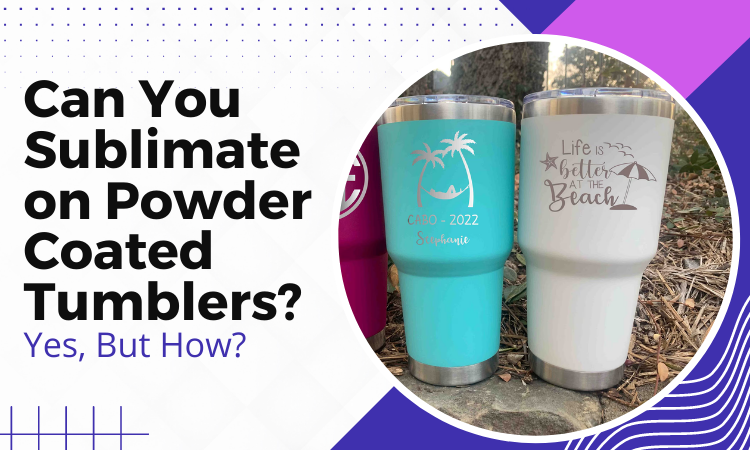
Can you sublimate on powder coated tumblers? This question comes up a lot because powder coated tumblers are popular for their durability and scratch resistance, and crafters want to know if they can add custom sublimation designs to them. The answer depends entirely on what type of powder coating the tumbler has.
Standard sublimation tumblers come with a thin polymer coating specifically designed for sublimation ink transfer. Powder coated tumblers are different. They have a thicker, more durable coating that was originally designed for protection, not printing. If the coating provides a sublimation-compatible polymer surface, the dyes can transfer into that layer under heat. In practice, chemistry alone is not enough information, so supplier testing or a proven blank matters more than the generic phrase “powder coated.”
Contents
- 1 Can You Sublimate on Powder Coated Tumblers? Which Coating Works
- 2 Sublimation Settings for Powder Coated Tumblers
- 3 How to Sublimate on Powder Coated Tumblers (Step by Step)
- 4 Powder Coated vs Standard Sublimation Tumblers
- 5 Common Problems with Powder Coated Tumbler Sublimation
- 6 Frequently Asked Questions
- 6.1 Can you sublimate on any powder coated tumbler?
- 6.2 What temperature do you sublimate powder coated tumblers?
- 6.3 Are powder coated sublimation tumblers more durable?
- 6.4 Why is my powder coated tumbler sublimation faded?
- 6.5 Can you sublimate on colored powder coated tumblers?
- 6.6 Do you need shrink wrap for powder coated tumblers?
Can You Sublimate on Powder Coated Tumblers? Which Coating Works
This is the most important thing to understand before you spend money on blanks or waste time trying to sublimate a tumbler that may not be compatible with sublimation ink.
| Coating Type | Works for Sublimation? | Why |
|---|---|---|
| Polyester-based powder coating | Often the safest starting point | Most aligned with normal sublimation guidance, but still best when seller-tested |
| Epoxy powder coating | Not a safe blind buy | More heat/yellowing-sensitive, do not assume sublimation-ready without proof |
| Hybrid (epoxy-polyester) | Test first | Can have better heat stability than pure epoxy, but “hybrid” alone does not prove sublimation readiness |
| Sublimation-ready powder/clear-coat system | Yes | Works when the seller or manufacturer has actually tested it for dye sublimation |
My tip: if a supplier does not specify the coating type, ask before buying. “Powder coated” alone does not tell you whether it will work for sublimation. The word you are looking for is “polyester” or “sublimation-ready powder coat.”
Sublimation Settings for Powder Coated Tumblers
Powder coated tumblers often need some testing compared to standard sublimation tumblers because results can vary by coating system, tumbler shape, and equipment.
| Method | Temperature | Time | Notes |
|---|---|---|---|
| Tumbler press | 360-365F | Machine-dependent | Some presses use multiple short cycles for full wraps |
| Convection oven | 375F | 5-7 min | Use shrink wrap, rotate halfway |
| Air fryer | 375F | 5-6 min | Experimental backup, use dedicated appliance |
Use the blank maker’s tested settings whenever possible. Powder coating can yellow or discolor if the temperature is too high, especially on white or light-colored coatings. Start at the lower end and increase only if the colors look faded after your first test press.
For complete tumbler and mug settings across all types, check the mug temperature and time guide. You can also use the sublimation temperature chart as a quick reference for all substrates.
How to Sublimate on Powder Coated Tumblers (Step by Step)
Step 1: Clean the tumbler. Wipe the surface with isopropyl alcohol or a lint-free cloth. Fingerprints and oils on the powder coating can prevent the ink from bonding properly and leave visible marks in the finished print. Handle the tumbler by the inside or top rim after cleaning.
Step 2: Print and mirror your design. Print your design on sublimation paper using sublimation ink. Make sure to mirror (horizontally flip) the image before printing. Size your design to match the tumbler dimensions. For a 20oz skinny tumbler, full-wrap templates are often in the 9.3 by 8.1-to-8.25 inch range, but exact dimensions vary by brand. Use the supplier’s template or measure your own tumbler before printing.
Step 3: Wrap the tumbler tightly. Tape the sublimation paper to the tumbler using heat-resistant tape. Make sure the paper is tight against the surface with no gaps or air bubbles. If you are using a convection oven, add shrink wrap over the tumbler and use a heat gun to shrink it snugly. The shrink wrap creates even pressure around the full circumference. If you are using a tumbler press, shrink wrap is usually optional because the press itself provides the pressure.
Step 4: Press or bake. If using a tumbler press, start around 360-365F and follow the blank or machine maker’s guidance for total press time. Some presses use multiple short cycles to complete a full wrap. If using a convection oven, place the wrapped tumbler on a rack at 375F for 5-7 minutes. Rotate halfway through for even color distribution.
Step 5: Cool and remove. Let the tumbler cool enough to handle safely, then remove the shrink wrap and peel the paper. If colors look faded, first confirm that the blank is actually sublimation-compatible and that you have even pressure. After that, make small test adjustments to time or temperature rather than making a large jump all at once.
My tip: keep oil and fingerprints off the tumbler after cleaning. This is one common cause of splotchy or uneven transfers on coated drinkware, along with loose wraps and uneven heat. Some crafters wear cotton gloves while handling cleaned tumblers.
Powder Coated vs Standard Sublimation Tumblers
If you are choosing between powder coated and standard sublimation-coated tumblers, here is how they compare:
| Feature | Standard Sublimation Coated | Polyester Powder Coated |
|---|---|---|
| Color vibrancy | Very vibrant, full color range | Good, but can be slightly muted on some colors |
| Scratch resistance | Good for everyday use | Often tougher as a finish, but varies by coating and supplier |
| Dishwasher care | Hand wash usually recommended | Hand wash still safest unless seller gives a specific dishwasher claim |
| Settings complexity | Standard settings, well documented | Slightly trickier, varies by coating brand |
| Availability | Widely available, many suppliers | Less common, need to verify coating type |
| Best for | Easiest, most predictable sublimation route | Buyers willing to test for added surface toughness |
For beginners, standard sublimation-coated tumblers are the easier and more predictable option. Powder coated tumblers are worth exploring once you are comfortable with the sublimation process and want to offer a tumbler with a tougher exterior finish, especially if you are selling tumblers to customers who will use them daily.
My tip: if you are just starting out selling tumblers, get comfortable with standard sublimation blanks first. Once your process is dialed in, try a small batch of powder coated tumblers from a seller who provides tested sublimation settings. That way you are not troubleshooting two things at once.
Common Problems with Powder Coated Tumbler Sublimation
Colors look faded or washed out. This usually means the temperature was too low or the time was too short. Increase time by 10-15 seconds first before raising the temperature. Also check that you are using a sublimation-compatible or seller-tested coating, because unverified powder-coat systems often produce weak, patchy, or non-existent transfers.
Yellowing on white areas. This is the opposite problem: temperature too high or time too long. Powder coating is more sensitive to overheating than standard sublimation coating. Reduce temperature by 5-10F and shorten the time. White and light-colored powder coatings show yellowing more than darker colors.
Splotchy or uneven transfer. Usually caused by fingerprints on the surface, loose shrink wrap, or uneven heat distribution. Clean the tumbler thoroughly with alcohol before wrapping. Make sure the shrink wrap is tight with no air bubbles. If using an oven, rotate the tumbler halfway through the cycle.
Design not transferring at all. If the ink barely transfers or washes off, the coating is likely not sublimation-compatible, or the blank has not been properly tested for sublimation use. If the coating itself is not sublimation-compatible, there is no reliable direct-sublimation fix. At that point, your best options are to switch to a proven sublimation blank or use a different decorating method such as UV DTF or laser engraving depending on the tumbler. For more transfer troubleshooting, see the sublimation not transferring guide.
Ghosting (double image). This happens when the paper shifts during heating. Tape the paper tightly and make sure the shrink wrap is snug. For detailed ghosting prevention tips, see the sublimation ghosting guide.
Frequently Asked Questions
Can you sublimate on any powder coated tumbler?
No. Do not assume that any random powder coated tumbler is sublimation-ready. In the consumer market, polyester-based or explicitly tested sublimation-ready coatings are the safest option, while other powder-coat systems should be treated as unverified unless the seller provides proven sublimation guidance.
What temperature do you sublimate powder coated tumblers?
A practical starting point is about 375°F for 5-7 minutes in a convection oven. For a tumbler press, start around 360-365°F and follow your blank or machine maker’s guidance, since press timing can vary by attachment and full-wrap method. Powder coating can yellow at higher temperatures, so start at the lower end and increase time gradually if colors look faded.
Are powder coated sublimation tumblers more durable?
Often, yes as an exterior finish. Powder coating is usually tougher and more scratch-resistant than a typical sublimation coating, but print longevity still depends on the specific blank, coating system, and care. Hand washing is still recommended for the best results on any sublimated drinkware.
Why is my powder coated tumbler sublimation faded?
Faded results on powder coated tumblers are usually caused by temperature being too low, pressing time being too short, or the coating not being sublimation-compatible. Try increasing the time by 10-15 seconds first. If that does not help, confirm with the supplier that the coating has been tested for sublimation. Unverified coatings often produce weak or non-existent transfers regardless of settings.
Can you sublimate on colored powder coated tumblers?
You can, but results are best on white or light-colored powder coating. Sublimation ink is transparent, so a dark coating will show through the design and alter the colors. A white coating produces the most vibrant and accurate colors. Pastel colors can work for some designs where the base color complements the design.
Do you need shrink wrap for powder coated tumblers?
Shrink wrap is strongly recommended for oven sublimation because it helps create even pressure around the tumbler. If you are using a tumbler press, it is often optional because the press itself provides the pressure. Without shrink wrap in an oven, the paper can shift during heating and cause ghosting or uneven transfers. Use a heat gun to shrink the wrap snugly before baking.

Emily loves making things special.
She’s also a mom and a wife who enjoys crafting and runs a small business from her home. She knows that the little things can make a house feel like a warm and loving home. This belief has led her to explore the exciting world of sublimation, a crafty way to add a personal touch to just about anything. Her website shares valuable information about sublimation, her crafty ideas, and tips.