Updated: July 17, 2026
My Quick Answer
Yes, you can sublimate on powder coated tumblers, but only when the coating system is compatible with dye sublimation and has been tested for that use. In the consumer craft market, polyester-based or explicitly sublimation-ready coatings are the safest starting point. If a seller only says “powder coated” without giving tested sublimation guidance, treat the blank as unverified and test one first.
Last Updated: July 2026
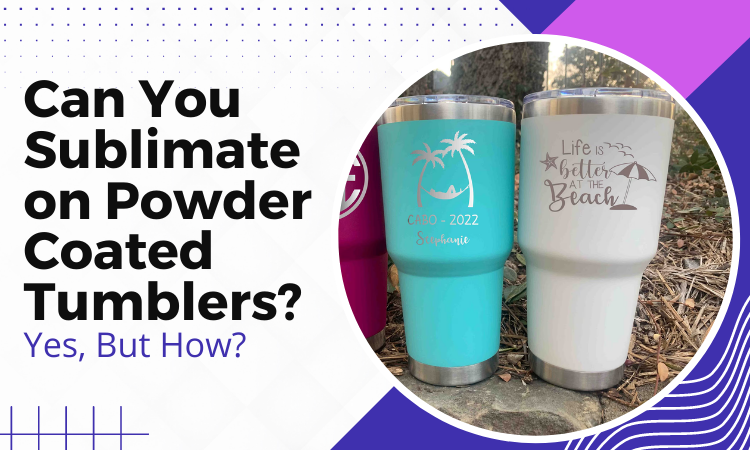
Can you sublimate on powder coated tumblers? This question comes up a lot because powder coated tumblers are popular for their durability and scratch resistance, and crafters want to know if they can add custom sublimation designs to them. The answer depends on the specific coating system and whether the finished blank has been tested for dye sublimation.
Standard sublimation tumblers come with a thin polymer coating specifically designed for sublimation ink transfer. Powder-coated tumblers use a cured coating system that may differ in thickness, chemistry and performance from the clear polymer coatings used on many conventional sublimation blanks. Some powder coatings are primarily protective finishes, while others are specifically formulated for heat-transfer decoration. Dye sublimation only works with polyester and polymer-coated substrates, so if the coating provides a sublimation-compatible polymer surface, the dyes can transfer into that layer under heat. In practice, chemistry alone is not enough information, so supplier testing or a proven blank matters more than the generic phrase “powder coated.”
Can You Sublimate on Powder Coated Tumblers? Which Coating Works
This is the most important thing to understand before you spend money on blanks or waste time trying to sublimate a tumbler that may not be compatible with sublimation ink.
| Coating Type | Works for Sublimation? | Why |
|---|---|---|
| Polyester-based powder coating | Often the safest starting point | Most aligned with normal sublimation guidance, but still best when seller-tested |
| Epoxy powder coating | Do not assume compatibility | The resin category alone does not establish dye uptake or resistance to the required transfer cycle |
| Hybrid epoxy-polyester coating | Test or verify first | A hybrid designation alone does not prove sublimation compatibility or predict the finished result |
| Sublimation-ready powder/clear-coat system | Yes | Works when the seller or manufacturer has actually tested it for dye sublimation |
My tip: if a supplier does not specify the coating type, ask before buying. “Powder coated” alone does not tell you whether it will work for sublimation. The most useful wording is “sublimation-ready,” “heat-transfer powder coating,” or a specific manufacturer statement confirming dye-sublimation compatibility. “Polyester” can be a positive clue, but it is not proof by itself.
Can You Sublimate on Black or Dark Powder Coated Tumblers?
You can, but the result is not what most beginners expect, and this is the single most misunderstood part of the whole topic. Sublimation ink is transparent and has no white, so on a black or dark powder coating your design does not sit on top as bright artwork. The colors mix with the dark surface underneath and come out muted, dark and shifted, and light colors barely show at all. If the dark coating is actually sublimation-compatible, it may accept the dye, but the dark base color will severely limit its visibility. With an unverified coating, both compatibility and visibility can be problems.
There is no press setting that fixes this, because it is how the ink works. If you need a bright, full-color design on a black tumbler, use a separate decorating system that provides an opaque white layer, such as a product specifically approved for decorating hard drinkware, UV DTF, or another manufacturer-rated transfer. Some white sublimation-compatible films can provide a printable base, but this becomes a layered transfer rather than direct sublimation onto the powder coating. Verify that the chosen product is approved for curved hard surfaces, the required press temperature, and the intended washing conditions.
Otherwise, design specifically for the dark base color. White areas in the artwork will remain the color of the tumbler, because standard sublimation printers do not print white ink. Some saturated colors may produce a subtle tone-on-tone effect on a compatible dark coating, but pale colors and fine details will usually have very little visibility.
Powder Coated Water Bottles, Cups and Other Blanks
Everything here applies beyond tumblers. Powder coated water bottles, cups, cans and mugs follow the same rule: the coating must be compatible with dye transfer and, ideally, identified or tested by the coating or blank maker for sublimation. Do not assume that an ordinary decorative or protective powder coat will work. Industrial powder coatings are not automatically unsuitable, since some industrial systems are made specifically for heat-transfer decoration, but a generic powder-coat description, resin name, color or gloss level does not prove compatibility. Treat any blank as unverified until the supplier confirms it is sublimation-ready, and test one before committing a batch. Curved and tapered shapes like bottles also need snug wrap and even pressure, exactly as they would with a standard tumbler.
Heat Warning: White and Light Coatings Can Discolor
Some white and light-colored powder coatings can yellow, discolor, lose gloss or, in severe cases, develop surface defects when exposed to more heat than their formulation can tolerate. The risk varies substantially by coating system. Use the blank maker’s tested settings whenever available. If no settings are provided, begin with a conservative test cycle rather than assuming a standard tumbler recipe transfers directly to the blank, and adjust only one variable at a time.
Sublimation Settings for Powder Coated Tumblers
Powder coated tumblers often need some testing compared to standard sublimation tumblers because results can vary by coating system, tumbler shape, and equipment.
| Method | Starting guidance | Notes |
|---|---|---|
| Tumbler press | Use the blank supplier’s tested temperature and total time | The required time depends on the press, heating element, blank and whether the tumbler must be rotated |
| Convection oven | Use the blank supplier’s tested oven cycle | Oven temperature, dwell time, wrap system and load size all affect the result |
| Dedicated craft convection appliance | Experimental unless supported by the blank maker | Do not use an appliance that will later be used for food |
There is no single set of settings that works for every powder-coated tumbler, so the values above are deliberately left to the blank supplier. Manufacturers publish tested figures for their own blanks; Sawgrass, for example, provides an official heat-press settings chart as a starting reference rather than a universal rule. If a supplier does not provide a tested cycle, treat any numbers you find as a rough example from one specific workflow, not a universal recipe, and confirm them by testing on a spare blank. A faded print does not automatically mean more heat is needed; first rule out an incompatible coating, poor contact, uneven heat and printing or color-management problems. Change only one variable at a time.
For complete tumbler and mug settings across all types, check the mug temperature and time guide. You can also use the sublimation temperature chart as a quick reference for all substrates.
How to Sublimate on Powder Coated Tumblers (Step by Step)
Step 1: Clean the tumbler. Wipe the surface with isopropyl alcohol or a lint-free cloth. Fingerprints, oils, dust and fibers can interfere with clean, even transfer and may leave visible marks in the finished print. Handle the tumbler by the inside or top rim after cleaning.
Step 2: Print and mirror your design. Print your design on sublimation paper using sublimation ink. Make sure to mirror (horizontally flip) the image before printing. Size your design to match the tumbler dimensions. For a 20oz skinny tumbler, full-wrap templates are often in the 9.3 by 8.1-to-8.25 inch range, but exact dimensions vary by brand. Use the supplier’s template or measure your own tumbler before printing.
Step 3: Wrap the tumbler tightly. Tape the sublimation paper to the tumbler using heat-resistant tape. Make sure the paper is tight against the surface with no gaps or air bubbles. If you are using a convection oven, add shrink wrap over the tumbler and use a heat gun to shrink it snugly. The shrink wrap helps hold the transfer paper firmly against the tumbler around its circumference. If you are using a tumbler press, shrink wrap is usually optional because the press itself provides the pressure.
Step 4: Press or bake. Follow the blank supplier’s tested temperature and time whenever they provide them. If they do not, treat any figure you find as a starting example to test rather than a guaranteed setting, and confirm it on a spare blank first. Some presses use multiple short cycles to complete a full wrap. Rotate during the cycle only if it is recommended for your oven, blank or tested workflow, or if testing shows a repeatable heat imbalance.
Step 5: Cool and remove. Let the tumbler cool enough to handle safely, then remove the shrink wrap and peel the paper. If colors look faded, first confirm that the blank is actually sublimation-compatible and that you have even pressure. After that, make small test adjustments to time or temperature rather than making a large jump all at once.
My tip: keep oil and fingerprints off the tumbler after cleaning. This is one common cause of splotchy or uneven transfers on coated drinkware, along with loose wraps and uneven heat. Some crafters wear cotton gloves while handling cleaned tumblers.
Powder Coated vs Standard Sublimation Tumblers
If you are choosing between powder coated and standard sublimation-coated tumblers, here is how they compare:
| Feature | Standard Sublimation Coated | Tested Sublimation-Ready Powder-Coated |
|---|---|---|
| Color vibrancy | Very vibrant, full color range | Good, but can be slightly muted on some colors |
| Scratch resistance | Good for everyday use | Can be tougher on some tested blanks, but product-specific, not guaranteed by the words “powder coated” |
| Dishwasher care | Hand wash usually recommended | Hand wash still safest unless seller gives a specific dishwasher claim |
| Settings complexity | Standard settings, well documented | Slightly trickier, varies by coating brand |
| Availability | Widely available, many suppliers | Less common, need to verify coating type |
| Best for | Easiest, most predictable sublimation route | Buyers willing to test for added surface toughness |
For beginners, standard sublimation-coated tumblers are the easier and more predictable option. Tested sublimation-ready powder-coated tumblers are worth exploring once you are comfortable with the sublimation process and want to evaluate a blank whose supplier documents improved exterior durability, especially if you are selling tumblers to customers who will use them daily.
My tip: if you are just starting out selling tumblers, get comfortable with standard sublimation blanks first. Once your process is dialed in, try a small batch of powder coated tumblers from a seller who provides tested sublimation settings. That way you are not troubleshooting two things at once.
Common Problems with Powder Coated Tumbler Sublimation
Colors look faded or washed out. Possible causes include an incompatible coating, insufficient or uneven heat, poor paper contact, an incorrect print profile or a partially blocked ink channel. First confirm the blank is intended for sublimation and that the wrap and heat are even. If those checks pass, make a small time adjustment within the blank maker’s recommended range before increasing the temperature.
Yellowing or discoloration of a white or light coating. This indicates that the coating may have exceeded its tolerated heat exposure, although contamination or coating defects should also be ruled out. Some powder coatings discolor more readily than others when overheated. Return to the supplier’s tested cycle if available. Otherwise, reduce either temperature or dwell time slightly, changing only one variable before retesting. White and light-colored coatings show yellowing more than darker ones.
Splotchy or uneven transfer. Usually caused by fingerprints on the surface, loose shrink wrap, or uneven heat distribution. Clean the tumbler thoroughly with alcohol before wrapping. Make sure the shrink wrap is tight with no air bubbles. If using an oven and your blank or tested workflow calls for it, rotate the tumbler partway through the cycle to even out the heat.
Design not transferring at all. If the ink barely transfers or washes off, the coating is likely not sublimation-compatible, or the blank has not been properly tested for sublimation use. If the coating itself is not sublimation-compatible, there is no reliable direct-sublimation fix. At that point, your best options are to switch to a proven sublimation blank or use a different decorating method such as UV DTF or laser engraving depending on the tumbler. For more transfer troubleshooting, see the sublimation not transferring guide.
Ghosting (double image). This happens when the paper shifts during heating. Tape the paper tightly and make sure the shrink wrap is snug. For detailed ghosting prevention tips, see the sublimation ghosting guide.
Frequently Asked Questions
Can you sublimate on any powder coated tumbler?
No. Do not assume that any random powder coated tumbler is sublimation-ready. In the consumer market, explicitly tested sublimation-ready coatings are the safest option. A polyester-based formulation may be a useful clue, but it should still be treated as unverified without product-specific guidance, and other powder-coat systems should be treated as unverified unless the seller provides proven sublimation guidance.
What temperature do you sublimate powder coated tumblers?
There is no single temperature that works for every powder-coated tumbler, so use the settings your blank supplier has tested for their product. If you cannot get supplier settings, treat any oven or press figure you find as an example to test on a spare blank, not a guaranteed recipe, and change only one variable at a time. If colors look faded, first rule out an incompatible coating, poor contact and uneven heat before assuming more heat is the answer.
Are powder coated sublimation tumblers more durable?
Sometimes. Some tested powder-coated blanks provide a tougher or more scratch-resistant exterior than some conventional sublimation-coated blanks, but this is product-specific and should not be assumed from the words “powder coated” alone. Print longevity still depends on the specific blank, coating system and care, and hand washing is recommended for the best results on any sublimated drinkware.
Why is my powder coated tumbler sublimation faded?
Faded results can come from an incompatible coating, insufficient or uneven heat, poor contact, or a printing and color-management issue. Confirm the blank’s sublimation compatibility and check the wrap and equipment before adding more heat. If the supplier provides a recommended range, adjust one variable at a time within that range. Unverified coatings often produce weak or non-existent transfers regardless of settings.
Can you sublimate on colored powder coated tumblers?
You can, but results are best on white or light-colored powder coating. Sublimation ink is transparent, so a dark coating will show through the design and alter the colors. A white coating produces the most vibrant and accurate colors. Pastel colors can work for some designs where the base color complements the design.
Do you need shrink wrap for powder coated tumblers?
Shrink wrap is strongly recommended for oven sublimation because it helps maintain close, consistent contact between the paper and the tumbler. If you are using a tumbler press, it is often optional because the press itself provides the pressure. Without shrink wrap in an oven, the paper can shift during heating and cause ghosting or uneven transfers. Use a heat gun to shrink the wrap snugly before baking.


Emily Johnson is a DIY crafter and the founder of SublimationGuides.com. She started out repairing and sewing clothes for her two sons, then discovered sublimation as a way to personalize her makes. Today she researches and shares honest, tested guides on sublimation settings, troubleshooting, and equipment.