Updated: September 24, 2026
This guide is information-only and contains no affiliate links.
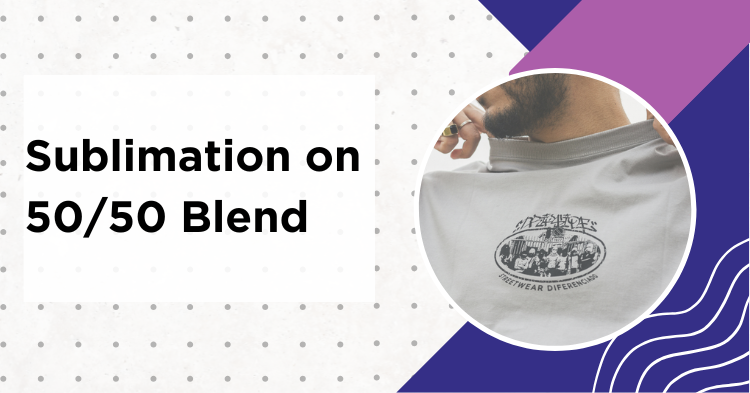
Sublimation on 50/50 polyester cotton blends works, but the result looks different from 100% polyester. Because sublimation dye is only taken up by the polyester fibers, a 50/50 shirt comes out softer and more faded, with a built-in vintage look. That can be a problem or a feature depending on your design. Below, you will find the starter settings, why the faded look happens, which blanks are safer to choose, and when DTF or HTV is the better option.
Quick Answer
Yes, sublimation on 50/50 polyester cotton works, but expect a softer, vintage-looking result rather than the bright finish you get on 100% polyester. Start with 375-385°F for 30-40 seconds at medium pressure, and pre-press the shirt for 5-10 seconds first. Use light-colored shirts and bold, high-contrast or distressed designs that suit the faded look. Only the polyester fibers hold the dye, so the more cotton in the blend, the more washed-out it looks. If you are still deciding which blend to buy, my full breakdown of what percent polyester for sublimation walks through every ratio and how to read a shirt tag before you order.
Last Updated: May 2026
Why 50/50 Blends Look Faded: The Chemistry
Sublimation only works on polyester. During pressing, heat drives the dye out of the paper and it diffuses into the polyester polymer, where it is trapped as the fabric cools. Cotton fibers cannot accept the dye at all, so they stay blank.
In a 50/50 blend, roughly half the fibers take the color and half stay white. Your eye blends the two together, which is why the print looks lighter, softer, and slightly washed out compared to the same design on 100% polyester. This is not a mistake or a settings problem. It is simply how the fabric reacts.
The practical takeaway: the higher the polyester percentage, the brighter and more durable the print. A 65/35 blend looks more vibrant than 50/50, and 100% polyester is the most vibrant of all. As you go the other direction, toward more cotton, the result gets progressively more faded.
50/50 Sublimation Settings (Temperature, Time & Pressure)
For 50/50 shirts, the safer approach is to start slightly lower than you would on 100% polyester. Cotton is more heat-sensitive, so pressing too hot can yellow the seams and increase ink bleed. Always follow your blank supplier first, then use these as a starting point.
| Setting | Recommended | Notes |
|---|---|---|
| Temperature | 375-385°F | Lower than 100% poly to protect cotton |
| Time | 30-40 seconds | Shorter time = crisper edges, less bleed |
| Pressure | Medium | Avoids over-saturating cotton areas |
| Pre-press | 5-10 sec | Removes moisture, reduces ghosting |
My tip: always test one shirt from the same batch before pressing a full run. Blends vary between brands, and a 5-10°F adjustment can make a real difference in how clean the edges come out.
How to Sublimate a 50/50 Polyester Cotton Shirt
- Choose a white or light-colored 50/50 polyester-cotton shirt.
- Print the design mirrored on sublimation paper.
- Pre-press the shirt for 5-10 seconds to remove moisture.
- Place the transfer face down and tape it securely.
- Press at 375-385°F for 30-40 seconds with medium pressure.
- Lift the press straight up and peel the paper carefully.
- Let the shirt cool flat before washing or folding.
Blend Comparison: 50/50 vs 65/35 vs 60/40 vs 100% Polyester
Polyester percentage is the single biggest factor in how your print turns out. This table shows what to expect from each common blend.
| Blend | Color Result | Best For |
|---|---|---|
| 100% Polyester | Brightest, most vibrant | Bold, colorful designs that need to pop |
| 65/35 Poly-Cotton | Vibrant with slight softness | Best balance of color and comfort |
| 50/50 Blend | Soft, vintage, faded | Distressed, retro, grunge designs |
| 60/40 Cotton-Poly | More faded than 50/50 | Heavy vintage look only |
If a customer wants bright, true-to-screen colors, steer them toward 65/35 or 100% polyester. If they want a soft, retro feel, 50/50 is perfect.
Best Shirt Colors for 50/50 Sublimation
Shirt color matters even more on blends than on 100% polyester. Sublimation cannot print white, so the shirt color shows through everywhere the design is light or transparent.
- White and light heather give the cleanest, most predictable results
- Light pastels work for soft, muted designs
- Dark blends mute the design heavily and hide light colors entirely
- Heathered blends naturally enhance the vintage look many crafters want
If this is your first 50/50 test, start with a white or light-gray shirt.
Best Designs for the 50/50 Vintage Look
Instead of fighting the faded result, lean into it. The 50/50 look suits certain design styles beautifully.
- Distressed and grunge designs that are meant to look worn
- Retro and vintage typography and color palettes
- Bold, high-contrast graphics that still read well when softened
- Single-color or limited-palette designs that do not rely on bright saturation
Avoid fine detail, small text, and designs that depend on vivid, true-to-screen color. Those show the faded effect most.
Bleed, Ghosting and Patchy Prints on 50/50
Blends are more prone to a few specific problems than 100% polyester. Here is what causes them and how to fix each one.
- Ghosting: the paper shifted, or moisture flashed to steam. Tape the transfer, pre-press to remove moisture, and lift the press straight up.
- Bleed beyond the design: too much heat or time pushed ink into the cotton areas. Drop the temperature 5-10°F and shorten the time.
- Patchy or uneven color: normal to a degree on blends because of fiber distribution, but uneven pressure makes it worse. Use a pressing pillow and even pressure.
- Yellow or scorched seams: temperature too high for the cotton content. Lower the temperature.
A protective sheet of butcher paper or parchment above and below the shirt helps prevent backside transfer and platen marks.
Best 50/50 Blank Shirt Brands
Not every shirt labeled “blend” is actually 50/50, so check the fabric tag. These are common, widely available 50/50 (or close) options crafters use.
- Gildan 8000 / G800 DryBlend – usually 50/50 cotton-polyester and widely stocked, but check the exact color because some Heather Sport / Heather colors may be 65/35 polyester-cotton
- Gildan 5000 / G500B Heavy Cotton – mostly a cotton shirt, but some adult and youth colorways may be 50/50. Do not assume the whole style works for sublimation; check the color-specific fiber content
- Next Level blends – softer feel, popular for retail-style shirts
- Be careful with tri-blends, including some Bella+Canvas Triblend styles – many include rayon, which can make sublimation results less predictable. Choose CVC or poly-rich styles when you want better color
Always confirm the exact polyester percentage on the product page, because the same style number can vary by color.
Sublimation vs DTF vs HTV on 50/50 Blends
If the faded look is not what your customer wants, sublimation may be the wrong method for a cotton-heavy blend. Here is how the three main options compare on 50/50.
| Method | Result on 50/50 | Best When |
|---|---|---|
| Sublimation | Soft, faded, vintage | You want the retro look, lowest cost |
| DTF | Bright, full-color, durable | You need vivid color on any fabric |
| HTV | Solid, opaque, durable | Simple designs, names, numbers |
For bright, true-color designs on cotton-heavy shirts, DTF is usually the better choice. For the vintage aesthetic at the lowest cost, sublimation wins. See the full sublimation vs HTV vs DTF comparison for more.
How to Wash 50/50 Sublimation Shirts
Because a 50/50 print starts with less dye bonded into the fabric than a 100% polyester print, gentle wash care matters even more. Harsh washing can make the already-soft print look dull faster.
Want to see how a 50/50 blend actually holds up? This crafter ran a full wash test on a sublimated 50/50 crewneck:
- Wash inside out in cold water on a gentle cycle
- Use a mild detergent, no bleach or oxidizers
- Skip fabric softener, which dulls the finish over time
- Hang dry or tumble dry on no-heat to protect the print
For the full protocol, see how to wash sublimation shirts without fading.
Selling 50/50 Sublimation: Set Expectations
If you sell shirts, the biggest mistake with 50/50 is not the pressing, it is the customer expectation. A buyer who expects bright, true-to-screen color will be disappointed by the faded result, even when you did everything right.
The fix is to frame the vintage look as a feature. Describe these shirts as “soft vintage feel” or “retro distressed style” in your listings, and use product photos that show the actual faded result, not a bright mockup. Avoid promising “bright sublimation colors” on 50/50 listings unless you show a real pressed sample photo. That way the look is exactly what the customer ordered.
Frequently Asked Questions
Can you sublimate on 50/50 cotton polyester shirts?
Yes, but only the polyester half of the blend holds the dye, so the result looks softer and more faded than on 100% polyester. Start at 375-385°F for 30-40 seconds with medium pressure. The look suits vintage and distressed designs well, but it is not ideal for bright, true-to-screen color.
What temperature for 50/50 sublimation?
Use 375-385°F for 30-40 seconds with medium pressure, which is slightly lower than the 400°F often used for 100% polyester. The lower temperature protects the cotton fibers from yellowing and reduces ink bleed. Always pre-press the shirt for 5-10 seconds first to remove moisture.
Why does my 50/50 sublimation look faded?
This is normal. Sublimation dye is only taken up by the polyester fibers, and a 50/50 shirt is half cotton. The cotton fibers stay blank, so the overall print looks lighter and more washed out. The higher the polyester percentage, the brighter the result, which is why 65/35 looks more vibrant than 50/50.
Will 50/50 sublimation fade more in the wash?
The print starts out more faded than 100% polyester because less dye bonds into the shirt overall. Harsh washing can make the already-soft print look dull faster. Washing inside out in cold water with mild detergent, skipping fabric softener, and air drying all help the print last longer.
Is 50/50 or 65/35 better for sublimation?
65/35 gives brighter, more durable results because it has more polyester, while still feeling softer than 100% polyester. Choose 65/35 when color vibrancy matters, and 50/50 when you specifically want the soft, vintage, faded look.
Does poly spray improve 50/50 sublimation results?
Polyester coating sprays can add a thin polymer layer that holds more dye, which can make colors look brighter on blends. The trade-off is an extra step, possible stiffness, and inconsistent results across fabrics. Test on a scrap first, because results vary by spray and shirt.
Is sublimation on 50/50 worth it?
It depends on the look you want. For a soft, retro, vintage aesthetic at the lowest cost, 50/50 sublimation is great. For bright, full-color designs on a cotton-heavy shirt, DTF usually gives a better result. Match the method to the design and the customer expectation.
Can you sublimate on black 50/50 shirts?
Not with standard sublimation alone. Sublimation ink is transparent and cannot print white, so black fabric hides most of the design. For black or dark 50/50 shirts, use DTF, HTV, white toner transfers, or a sublimation-on-vinyl workaround instead. See our sublimation on dark shirts guide for the options.
Will sublimation wash out of a 50/50 shirt?
It should not wash out completely because the dye is embedded within the polyester fibers. However, the print starts softer because only part of the shirt is polyester, and harsh washing can make it look dull faster. Cold water, mild detergent, and air drying help it last longer.
Can you sublimate on 50/50 hoodies or sweatshirts?
Yes, if the hoodie or sweatshirt is light-colored and contains enough polyester, but the result will still look softer and more vintage than on 100% polyester. Use the same conservative starter settings, protect seams and pockets from press marks, and test one small area first because thicker fleece can need slightly different pressure.
Can you sublimate on 100% cotton?
Not with standard sublimation, because cotton has no polyester for the dye to bond with. The print would wash out almost completely. For 100% cotton, use DTF, HTV, a sublimation-friendly coating spray, or special cotton transfer products instead.
Related Guides
- 60/40 Blend Heat Press Settings – for cotton-heavy blends
- How to Wash Sublimation Shirts – care protocol that preserves prints
- Sublimation on Dark Shirts – workarounds for dark fabric
- Sublimation vs HTV vs DTF – which method to choose
- Sublimation Temperature Chart – settings for every substrate
- Sublimation Not Transferring – if the design will not transfer
When 50/50 Sublimation Makes Sense
Sublimation on 50/50 polyester cotton is all about expectations. The faded, vintage result is not a failure, it is the natural outcome of dye bonding to only half the fibers. Start at 375-385°F for 30-40 seconds, choose light shirts and designs that suit the soft look, and the blend becomes a strength rather than a problem. If a project needs bright, true color on cotton-heavy fabric, reach for DTF instead. Match the method to the look, and 50/50 shirts become much easier to sell honestly.


Emily Johnson is a DIY crafter and the founder of SublimationGuides.com. She started out repairing and sewing clothes for her two sons, then discovered sublimation as a way to personalize her makes. Today she researches and shares honest, tested guides on sublimation settings, troubleshooting, and equipment.