Updated: September 14, 2026
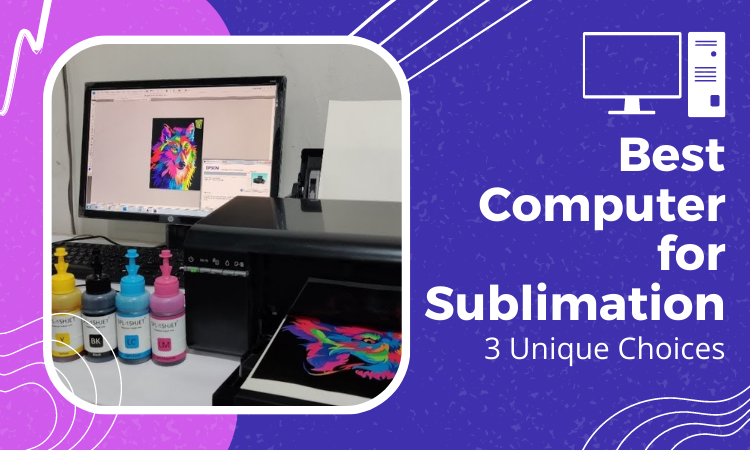
Looking for the best computer for sublimation? Here is the honest answer most buying guides will not give you: you almost certainly do not need an expensive one. Sublimation design is light work for a modern computer, so the best laptop for sublimation is usually a solid mid-range machine, not a $2,000 creator or gaming laptop. This guide shows you the specs that matter, how to tell if the laptop you already own is enough, and three sensible buying options for 2026 if you do want to buy.
My Quick Answer
The best computer for sublimation is usually a current Windows or Mac computer with 16GB of RAM, an SSD, and confirmed compatibility with your printer software. An 8GB machine can be adequate for basic Canva, Silhouette Studio and print-utility use, but 16GB is the better target for a new purchase. You normally do not need a gaming GPU or a workstation-class processor.
Spend the extra money on a good sublimation printer, ink and blanks, not on an overpowered computer.
Last Updated: July 2026
Do You Even Need a New Computer for Sublimation?
Before you spend anything, check what you already have, because most everyday sublimation workflows are relatively light. The work is designing in a program like Canva, Silhouette Studio or Photoshop and sending the file to your printer. Browser-based design tools and simple print layouts need little processing power, although large Photoshop files, complex vector artwork and heavy multitasking can benefit from more memory and a faster processor.
Here is how to check your current machine in under a minute. On Windows, right-click the Start button, open System, and look at Installed RAM and the processor line. On a Mac, click the Apple menu, choose About This Mac, and read the Memory and Chip lines. If the computer has at least 8GB of RAM, an SSD and an operating system supported by your design software and printer driver, it is probably adequate for a basic sublimation workflow. A laptop that still handles browsing and everyday tasks smoothly will often be enough, provided its operating system and processor are supported by the printer and design software. Check those requirements before buying anything new, and put the money toward ink and blanks instead.
The Real Specs That Matter for Sublimation
As a reference point, Sawgrass Print Utility, the software that drives its sublimation printers, officially lists 8GB of RAM as the minimum and 16GB or more as recommended. It requires a 64-bit dual-core processor, with an Intel Core i5 or AMD Ryzen recommended, at least 2GB of free storage, and a minimum screen resolution of 1440 x 900 at 100% scaling. Windows on ARM is not supported, while Apple silicon is supported natively. Adobe Photoshop also lists 8GB of RAM as the minimum and 16GB or more as recommended. Photoshop has additional graphics and operating-system requirements, but a current integrated GPU is normally sufficient for ordinary sublimation layouts and photo editing. These requirements support 16GB as a sensible target, not as a maximum.
| Component | Minimum | Comfortable | Why it matters |
|---|---|---|---|
| RAM | 8GB | 16GB | The one spec worth paying for. 16GB helps when you keep several apps and large design files open at once |
| Processor | Dual-core 64-bit | Modern Intel i5 / AMD Ryzen 5 / Apple silicon | Any current mid-range chip is plenty; you will not push it hard |
| Storage | 256GB SSD with free space | 512GB SSD | 256GB can work for a light workflow, but 512GB leaves more room for apps, photos, templates and backups |
| Display | Decent IPS screen | Wider-gamut IPS or OLED | A wider-gamut, reasonably accurate display makes design easier, but it does not guarantee the pressed result matches the screen. Reliable color still needs correct ICC settings and, for color-critical work, a calibrated display |
| Graphics | Current integrated graphics | Current integrated graphics or better | A dedicated gaming GPU is unnecessary for typical craft layouts, but check the requirements of demanding apps such as Photoshop or CorelDRAW |
My tip: store important customer artwork and production files in a separate backup or a reputable cloud service. A larger internal SSD is not a substitute for a real backup.
What NOT to Overspend On
For a typical sublimation-only workflow, you usually do not need a dedicated gaming GPU, 32GB of RAM or a 4K display. Those upgrades may still make sense if the computer will also handle large layered Photoshop files, professional photography, video editing, 3D work or other demanding tasks. Buy for your complete workload, not for sublimation alone. Guides that push $2,000 gaming or creator laptops are overspecing a light task.
Best Laptop for Sublimation: 3 Options for 2026
If you do want to buy, here are three options across budgets. All meet the needs of a typical sublimation workflow when purchased in the configurations described below, although the 8GB ASUS is the minimum-level option rather than the most future-proof choice. Whichever you pick, check the exact listing and configuration before ordering, because model families are sold in many versions.
As an Amazon Associate I earn from qualifying purchases, at no extra cost to you.
Budget Pick: ASUS Vivobook Go 15
The Vivobook Go 15 E1504FA is sold in several configurations, so check the full model number rather than relying on the family name alone. For a budget sublimation laptop, look for a Ryzen 3 or Ryzen 5 version with at least 8GB of RAM and a 256GB or larger SSD. Be aware that the memory is soldered on many E1504FA configurations and cannot be upgraded later. Check whether the listing ships with Windows 11 in S Mode. If it does, you will need to switch out of S Mode before installing traditional desktop software; that switch is free but one-way. It is adequate for Canva, Silhouette Studio and straightforward print preparation. An 8GB configuration can also run Photoshop, but 16GB is preferable if Photoshop, large files or frequent multitasking are part of the workflow.
Everyday Value: Lenovo IdeaPad Slim 5, Choose the Display Carefully
The IdeaPad Slim 5 is available in many different configurations, so check the exact listing before buying. Look for an AMD Ryzen 5, Ryzen 7 or Ryzen AI version with at least 16GB of RAM, a 512GB SSD and, ideally, the 100% sRGB display option. Some lower-priced versions use a much narrower-gamut panel, and not every 16-inch model includes a touchscreen. The processor is more than powerful enough either way; the display specification is the detail most worth checking. This is a strong middle-ground option for sublimation crafters who want 16GB of memory without paying for a premium laptop.
Premium and Color-Focused: MacBook Air
If you prefer macOS, a MacBook Air is an excellent premium option. Its base 16GB of memory, quiet fanless design and high-quality Liquid Retina display make it comfortable for design work, although its performance is far beyond what sublimation alone requires. Apple has since moved to the M5 generation, so the M4 model linked below is a previous-generation machine rather than Apple’s latest MacBook Air. It can be a strong value if it is meaningfully discounted compared with a similarly configured M5 model. Notice this is the Air, not the Pro. Other guides recommend a MacBook Pro 16 or a 32GB creator laptop here, but for sublimation that is money you do not need to spend.
Windows users who prefer OLED can consider an ASUS Vivobook S OLED with at least 16GB of RAM, but check the exact model’s color specifications and remember that OLED alone does not guarantee accurate screen-to-print matching.
Compatibility Details to Check Before Buying
Before ordering a laptop, verify the exact configuration rather than relying only on the product-family name. Confirm that your printer driver and print software support its operating system and processor. Also check whether the laptop has the USB ports you need, since very thin models sometimes have only USB-C and may need an adapter or hub for a printer that connects by USB. Check whether the memory can be upgraded, because budget models often have soldered RAM, so an 8GB machine cannot be expanded to 16GB later. Finally, some inexpensive Windows laptops ship in S Mode, which must be disabled before installing traditional desktop software, and leaving S Mode is intended to be permanent, so understand that limitation before buying.
Mac or Windows for Sublimation?
For sublimation itself, it honestly does not matter much. The design programs crafters rely on run on both platforms, so pick the one you are comfortable with. Apple silicon Macs (the M-series chips) are supported natively by Sawgrass Print Utility, so Mac users are well covered.
There is one modern trap worth knowing, and it is on the Windows side. If you use or plan to buy a Sawgrass printer, avoid Windows laptops powered by Qualcomm Snapdragon processors unless Sawgrass adds official Windows-on-ARM support in the future. As of July 2026, Sawgrass Print Utility does not support Windows on ARM, the platform used by many laptops powered by Qualcomm Snapdragon processors, including numerous Copilot+ PCs. Choose an Intel or AMD Windows laptop, or an Apple silicon Mac.
Buying Warning: Sawgrass and Windows ARM
If you use a Sawgrass printer, avoid Windows laptops built on ARM (Qualcomm Snapdragon), which now power many new Copilot+ machines. As of July 2026, Sawgrass Print Utility does not run on Windows ARM. Stick to an Intel or AMD Windows laptop, or an Apple silicon Mac, which Sawgrass supports natively. All three of our picks above are safe.
Epson EcoTank users do not need Sawgrass Print Utility, but they should still verify that the exact printer driver and any third-party color or RIP software support the computer’s operating system and processor architecture. Compatibility should not be assumed just because the printer uses USB or Wi-Fi.
Which Software Runs on What?
This is the part that actually decides your platform, so here is the quick reference. Always check the current version requirements, since older releases can have different support.
| Software | Windows | Mac |
|---|---|---|
| Canva | Yes, browser or app | Yes, browser or app |
| Silhouette Studio | Yes; check current OS requirements | Yes; check current OS requirements |
| Cricut Design Space | Yes; internet needed for setup, sign-in, syncing and some features; downloaded projects have limited offline support | Yes; internet needed for setup, sign-in, syncing and some features; downloaded projects have limited offline support |
| Photoshop / Illustrator | Yes; check hardware and OS requirements | Yes; Apple silicon supported |
| CorelDRAW Graphics Suite | Yes; check version requirements | Yes; current versions support Apple silicon |
| MySawgrass / DesignMate | Yes, browser-based | Yes, browser-based |
| Sawgrass Print Utility | Yes on 64-bit Intel/AMD; Windows ARM not supported | Yes; Apple silicon natively |
For a deeper look at the design side, see our guide to the best sublimation design software.
Does the Computer Affect Print Quality?
The price or processing power of the computer does not directly make a sublimation print more vibrant or sharper. A $2,000 laptop will not produce better color simply because it is faster than a $500 laptop.
However, the software running on the computer is an important part of the printing workflow. File resolution, scaling, export settings, printer drivers, your sublimation ICC profile and color-management settings can all affect the final result. Faded or inaccurate colors can also come from the printer, ink, paper, blank, or the press temperature, time and pressure. In other words, you do not need an expensive computer for good print quality, but you do need a compatible computer and a correctly configured design and printing workflow.
What About a Sublimation Business?
If you are moving from hobby to selling, the advice barely changes, but this is where 16GB of RAM earns its place. A common small-business workload is running a design app, browser tabs for your shop and email, and printer software at the same time, which is where 16GB of RAM becomes especially useful. A compatible current Windows or Mac laptop with 16GB of RAM and a 512GB SSD is enough for many small sublimation businesses. Larger Photoshop files, batch production, extensive product photography or several business apps at once may justify more memory or storage, but a gaming or workstation laptop is still unnecessary for most small shops. Put your bigger budget into the printer and ink, and read our guide to starting a sublimation printing business.
Frequently Asked Questions
Do you need a good computer for sublimation?
No. Sublimation design software is light, so most reasonably equipped current Intel- or AMD-based Windows laptops and Apple silicon Macs with an SSD, at least 8GB of RAM and compatible printer software can handle a basic workflow. A gaming graphics card and 32GB of memory are unnecessary for sublimation alone.
Can I use my current laptop for sublimation?
Very likely yes. If it has 8GB of RAM or more, a supported operating system, a reasonably recent processor and an SSD, it will usually run your design software and printer fine. Check the requirements of your exact printer and design software before buying anything new, especially with Windows-on-ARM laptops, Chromebooks and older operating systems.
How much RAM do I need for sublimation?
8GB is the workable minimum and 16GB is comfortable, especially if you run several apps at once or plan to sell. More than 16GB is usually unnecessary for sublimation alone, but it can help with unusually large files, heavy Adobe workflows or other demanding work.
Is a Mac or Windows better for sublimation?
Both work well and the main design programs run on each. Apple silicon Macs are natively supported by Sawgrass. The one thing to avoid if you use a Sawgrass printer is a Windows ARM (Snapdragon) laptop, which its software does not support as of July 2026. Otherwise pick what you prefer.
Does the computer affect sublimation print quality?
The computer’s price and processing power do not directly improve print quality. However, the file resolution, printer driver, ICC profile, scaling and color-management settings used on the computer can affect sharpness and color. Good results depend on the complete design, printing and pressing workflow.
Do I need a laptop or a desktop for sublimation?
Either works. A laptop offers more flexibility and can be used near the printer, while a desktop with comparable specifications is equally capable and may offer better value or easier upgrades.
These recommendations are based on current manufacturer specifications, software requirements and platform compatibility rather than hands-on testing of every configuration.
Related guides: Best Sublimation Printer for Beginners · Best Sublimation Design Software · Sublimation ICC Profile · Sublimation Printer Settings · Sublimation Printing Business


Emily Johnson is a DIY crafter and the founder of SublimationGuides.com. She started out repairing and sewing clothes for her two sons, then discovered sublimation as a way to personalize her makes. Today she researches and shares honest, tested guides on sublimation settings, troubleshooting, and equipment.