
Updated: September 24, 2026
This post contains affiliate links. As an Amazon Associate I earn from qualifying purchases at no extra cost to you.
Vevor heat press troubleshooting comes down to a handful of common problems that many owners run into sooner or later. The display reads way hotter than the actual plate temperature, the machine keeps beeping, or it just refuses to heat up at all. The good news is that most of these issues have simple fixes you can do yourself without voiding the warranty.
My Quick Answer
The most common Vevor heat press issue reported by many users is temperature inaccuracy. Some presses read 15-25°F higher than the actual plate temperature, but the offset varies by model and unit, so check your own platen with an infrared thermometer first. Grab an infrared thermometer, check the real temp, and adjust your settings accordingly. For everything else (not heating, error codes, beeping, shutting off), check fuses, wiring, and power supply first. Many simple issues are quick checks, but anything involving wiring, a relay, fuse replacement, or repeated error codes should be handled carefully or sent to support.
Last Updated: May 2026
Quick Diagnosis: Find Your Vevor Problem Fast
Match your symptom with the row below to jump straight to the likely cause. Detailed fixes follow further down.
| Symptom | Likely Cause | Quick Fix |
|---|---|---|
| Display reads too hot | Sensor offset (common) | Check with IR thermometer, adjust settings |
| Not heating at all | Blown fuse or loose wire | Check fuse, reseat connections |
| E1 / E2 / E3 on display | Sensor or control error | See error code table below |
| Black dots / marks on print | Uneven pressure or platen residue | Clean platen, even out pressure |
| Light blinking / won’t start | Power sequence or safety lock | Unplug both ends, wait 10s, replug |
| Keeps beeping | Timer done or temp reached | Normal alert, or reset timer |
| Keeps shutting off | Overheat protection or wiring | Cool down, check outlet and cord |
5-Step Vevor Heat Press Troubleshooting Checklist
When something goes wrong, work through these five steps in order before assuming the press is broken:
- Check the wall outlet and power cord for a solid connection
- Let the press cool, then inspect the fuse
- Verify the real platen temperature with an infrared thermometer
- Reseat any attachment plugs or platen connectors
- If the same error code, blinking light, or heating problem returns, stop using the press and contact Vevor support
Vevor Heat Press Troubleshooting: Common Problems and Fixes
Vevor makes budget-friendly heat presses that work surprisingly well for the price. But like any affordable machine, they come with quirks. The issues below are what real Vevor owners report most often. On forums, in Amazon reviews, and across crafting communities. Each fix is listed from simplest to most involved, so always start at the top.
1. Temperature Reads Higher Than Actual (A Common Vevor Issue)
This is the single most reported problem with Vevor heat presses, and it catches almost everyone off guard. The display might say 380°F, but the actual plate temperature is closer to 355-365°F. This is not necessarily a defect. Many budget presses read higher than the actual platen temperature. The offset is model-specific, so verify your own platen with an IR thermometer before changing all your settings.
An infrared thermometer is the quickest way to check what the plate is actually reaching, though a reading from a bare, shiny platen can be high or low because of emissivity and reflected heat, so treat it as a rough check and confirm with heat-test strips or a surface contact probe. Point it at the center of the platen after the press has been at the set temperature for at least 5 minutes. Then check the corners too. They typically run 3-5°F cooler than the center.
Here is a general offset range based on user testing across several Vevor models. Treat it as a starting point, not a guarantee for your specific unit:
| Display Shows | Actual Plate Temp (approx.) | Set This Instead |
|---|---|---|
| 300°F | 280-285°F | 315-320°F |
| 350°F | 332-338°F | 365-370°F |
| 380°F | 358-368°F | 395-400°F |
| 400°F | 385-392°F | 410-415°F |
My tip: Write down your specific offset after testing. Every Vevor is slightly different, and knowing your machine’s exact variance will save a lot of wasted blanks. Smaller portable models (12×10″) tend to have bigger offsets. Up to 25°F in some cases.
Some newer Vevor models have a calibration function in the setup menu, often reached by holding the set button for several seconds until an offset option appears. The exact steps vary by model, so check your manual. Not all models have this feature.
2. Vevor Heat Press Not Heating Up
The press powers on, the display lights up, but the platen stays cold. This is the second most common complaint, and it usually comes down to one of these causes:
Check the internal fuse first. Open the control box and look for a glass tube fuse. If it looks dark or cloudy on the ends, it is blown. Replace it with a fuse that has the exact same amperage and voltage rating. Using a higher-rated fuse can damage the machine or create a fire hazard.
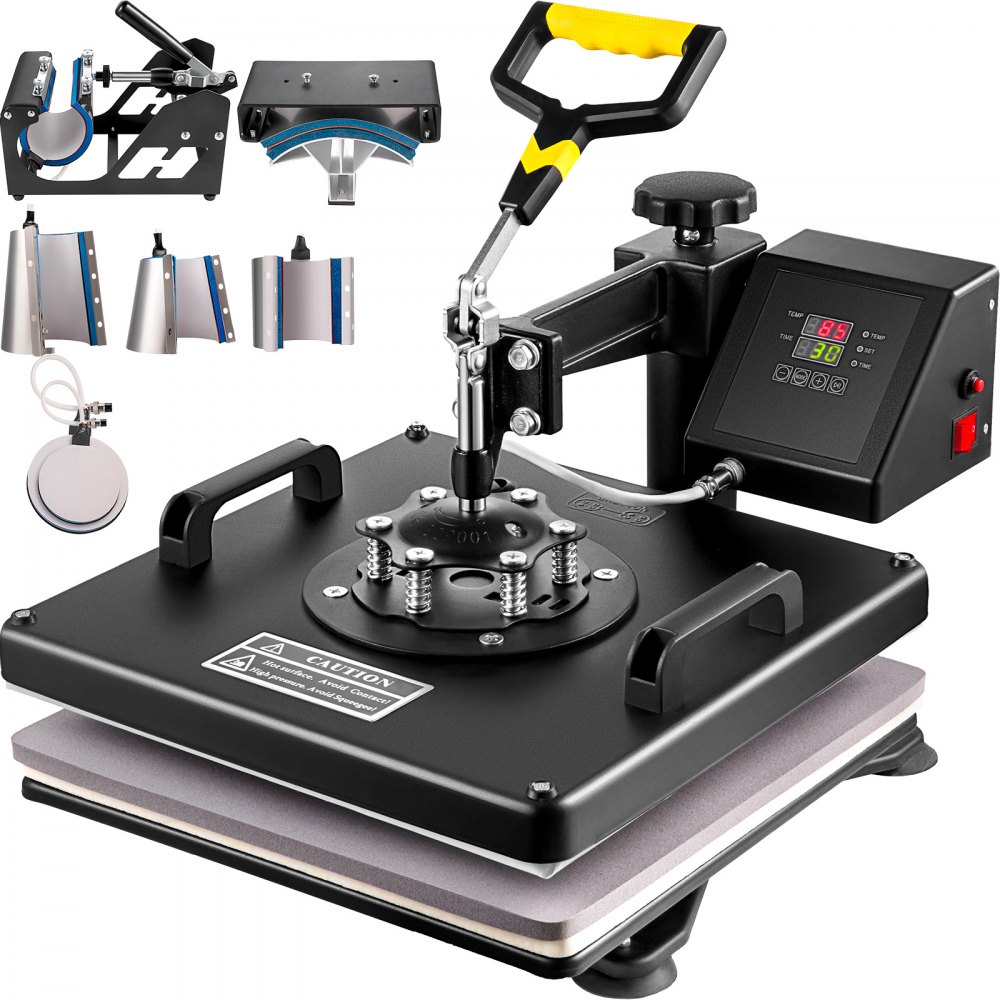
Check the platen wire connections. The wires running from the control box to the heating element can work loose over time, especially on 5-in-1 and 8-in-1 models where attachments get swapped regularly. Open the housing and look for any disconnected or burned connectors. If a solder joint looks cracked, it needs to be re-soldered.
Check the relay switch. The relay is what turns the heating element on and off. If you hear a faint clicking when the press tries to heat but nothing happens, the relay is likely failing. This is a cheap part to replace but does require basic soldering skills.
Check your power source. Vevor heat presses draw significant current. Plugging into a power strip or sharing an outlet with other high-draw appliances can cause insufficient power delivery. Always use a dedicated wall outlet.
3. Vevor Heat Press Error Codes (E1, E2, E3)
When an error code appears on the display, the press stops heating as a safety measure. Vevor error-code meanings vary by controller and model, and not every manual documents them clearly. The table below shows the most common user-reported meanings, but always compare the code with your exact manual before replacing parts.
| Error Code | Meaning | Fix |
|---|---|---|
| E1 | Temperature sensor error or temperature too high | Turn off, let cool 15 min. Check sensor wire connections. Clean any dust from vents. If it persists, the sensor needs replacement. |
| E2 | Heating element problem or temperature out of range | Check heating element connections to the control board. Test with a multimeter for continuity. If open circuit, the element needs replacement. |
| E3 | Heating-element or temperature-control fault, depending on controller | On some controllers, E3 can point to a heating-element or temperature-control fault. Turn the press off, let it cool, check for visible connector issues, and contact Vevor support if the code returns. Do not assume the platen is dead until your manual or support confirms it. |
| PF | Power failure detected | Check power supply, try a different outlet. If the outlet is fine, the power supply board inside the machine may be failing. |
My tip: Before opening anything, try a simple power cycle. Unplug the machine for 60 seconds, then plug it back in. This clears E1 errors about half the time. If the code comes back immediately, then it is time to dig deeper.
4. Vevor Heat Press Keeps Beeping
Constant beeping is one of those problems that will drive you up the wall. There are three common causes, and they are very different from each other.
Beeping after opening the press is usually just the timer alarm telling you the cycle is done. Press any button to silence it. On some models, the alarm continues until you manually reset the timer.
Nonstop beeping that starts randomly often points to a loose connector plug at the back or bottom of the machine. This is especially common on 8-in-1 models after a few months of switching attachments. Open the housing and reseat all connector plugs firmly.
Beeping combined with the machine shutting down indicates overheating. The press hit its thermal safety limit. Let it cool completely with the lid open for 20-30 minutes. Make sure nothing is blocking the ventilation holes. If the room temperature is very high, that can contribute too.
5. Uneven Pressure and Faded Prints on One Side
If prints come out vibrant on one side and faded on the other, the pressure is not even across the platen. This is more common than you would think, especially with brand-new machines fresh out of the box.
The paper test: Place a sheet of regular paper on the lower platen, close the press, and try to pull the paper out. Repeat this in all four corners and the center. The resistance should feel the same everywhere. If the paper slides out easily in one corner, that area has less pressure.
Most Vevor models have a pressure adjustment knob at the top. Turn it clockwise to increase pressure, counterclockwise to decrease. The trick is making small adjustments and testing after each one. Some models also have spring-loaded bolts underneath that can be individually adjusted for corner-to-corner balance.
If adjusting the knob does not fix it, check whether the platen got bumped during shipping. A slightly bent hinge or misaligned upper platen will cause permanent uneven pressure. This is a warranty issue. Contact Vevor with photos.
6. Black Marks or Residue on Fabric
Finding dark streaks or black residue on a freshly pressed item is frustrating, especially if it is a customer order. This is not the same as scorching. Scorching yellows the fabric, while residue leaves actual black marks.
The cause is almost always buildup on the upper platen. Sublimation ink residue, adhesive from tape, and melted vinyl remnants accumulate over time and transfer onto the next item. The fix is straightforward: clean the upper platen with a damp cloth when the press is warm (not hot). For stubborn residue, a non-abrasive cleaner works well.
Prevention: Always use a Teflon sheet or butcher paper between the platen and your project. This is one of those things that takes two seconds but saves hours of frustration. Once you start doing it consistently, black marks become a thing of the past.
7. Vevor Heat Press Keeps Shutting Off
The press powers on, starts heating, then suddenly shuts off completely. This is different from error codes or beeping. The machine just goes dead.
Check the circuit breaker or fuse in your home electrical panel. Vevor heat presses pull 1,200-1,800 watts depending on the model. If the outlet is on a circuit shared with other appliances, the breaker may trip under load. Try moving the press to a dedicated circuit.
Check the internal wiring for damage. Wires that have been pinched, kinked, or melted from heat exposure can cause intermittent short circuits. The built-in safety system cuts power when it detects a short. Open the housing, check for any wires touching the heating element or showing damaged insulation, and replace if needed.
A failing heating element can also draw excessive current before it dies completely, tripping the internal fuse or home breaker. If the shutoffs become more frequent over time, the heating element is likely on its way out.
8. How to Switch Between Celsius and Fahrenheit
Many Vevor presses arrive set to Celsius, which causes confusion when recipes and guides list temperatures in Fahrenheit. The switching method depends on the model:
Method 1 (most common): With the machine powered on, press and hold both the + and − buttons at the same time for 3-5 seconds. The display should toggle between °C and °F.
Method 2 (newer digital models): Press the SETUP or SET button, then use the arrow keys to find the temperature unit setting. Switch between F and C, then press SET again to confirm.
If neither method works, check the back or bottom of the control box for a small toggle switch. A few older Vevor models use a physical switch instead of a software setting.
What the Vevor Display Codes Mean (SP, PV, SH)
Vevor controllers use abbreviations that confuse a lot of new owners. The exact labels vary by model, so always confirm against your manual, but these are the common meanings on digital heat press controllers:
- SP (Set Point). The target temperature you set the press to reach
- PV (Process Value). The actual real-time temperature the sensor reads
- SH. On many Vevor models this shows the current or “show” temperature; if your display flips between SP and SH, it is usually toggling between your set target and the live reading
If your display shows SP when you expected SH (or the reverse), you are most likely seeing the set value instead of the live value. Press the set or mode button once to toggle back. This is a display mode, not a fault. When in doubt, verify the real plate temperature with an infrared thermometer rather than trusting the display alone.
Vevor Heat Press Black Dots or Spots on Your Print
Black dots are different from larger black residue marks. Dots usually look like tiny specks in the print area, while residue marks often appear as streaks or smudges from the upper platen.
Black dots or small dark spots appearing on a pressed item (for example at 385°F for 45 seconds on an all-in-1 press) usually point to one of these causes:
- Uneven pressure creating hot contact points on the platen
- Residue buildup on the upper platen transferring onto the item
- Moisture in the blank flashing to steam under heat
- Too much heat or time for that specific blank
Start by cleaning the platen when warm, then pre-press the blank for a few seconds to drive out moisture. If dots persist, drop the time by 5-10 seconds and re-test on a scrap. Always use butcher paper or a Teflon sheet between the platen and your item.
Where Is the Vevor Heat Press Fuse Located?
If your Vevor press has no power or stopped heating suddenly, a blown fuse is a common cause. The fuse location varies by model, but on most Vevor heat presses you will find it in one of these spots:
- Inside or beside the power inlet socket on the back of the control box (a small pull-out drawer)
- On the control board inside the housing (requires opening the unit)
- An inline fuse on the power cord on some models
Always unplug the press and let it cool completely before checking. Replace a blown fuse with the exact same rating printed on the fuse or in your manual. Never substitute a higher-rated fuse, because the fuse is a safety device. If the new fuse blows again immediately, stop and contact Vevor support, because that points to a deeper electrical fault.
How to Calibrate Your Vevor Heat Press (Zero / Offset Button)
Some Vevor models (including units like the SJYHPM230) have a calibration or “zero” function that lets you correct the temperature offset so the display matches the real plate temperature.
- Look for a set, zero, or offset button on the control panel, often a secondary function of the main set button
- The calibration setting is usually reached by holding the set button for several seconds until a configuration menu appears
- Enter the difference between your IR thermometer reading and the display as the offset value
Because button layouts and menu steps differ across Vevor models, check your specific manual for the exact sequence. If you cannot calibrate, the simpler workaround is to just adjust your press settings to account for the offset (see the settings table below).
Vevor Heat Press Light Blinking or Won’t Start
A blinking light or a press that will not start usually traces back to the power sequence or a safety lock rather than a broken machine. Try this reset:
- Unplug the press from both the wall and (on mug/tumbler presses) the control unit
- Wait at least 10 seconds for the capacitors to discharge
- Plug the control unit in first, then the wall outlet (mug presses are sensitive to plug order)
- If a blink pattern continues, note how many blinks and check your manual, as some models use blink codes for sensor faults
Vevor Model-Specific Troubleshooting: 5-in-1, 8-in-1, Clamshell, Mug Press
Vevor sells several heat press styles, and the most common failure differs by model. Use this table to narrow down where to look first.
| Vevor Model Type | Common Issue | First Thing to Check |
|---|---|---|
| 5-in-1 / 8-in-1 combo | Attachment not heating | Reseat the attachment plug before powering on |
| Clamshell press | Faded side or uneven print | Paper pressure test in all four corners |
| Swing-away press | Uneven pressure after shipping | Check platen alignment and hinge movement |
| Mug press attachment | Controller lights up but mug heater stays cold | Check plug order and attachment connector |
| Hat / cap press | Faded or patchy transfer | Check pressure, cap shape, and pad contact |
Vevor Heat Press Sublimation Settings (Adjusted for Temperature Offset)
If your press reads higher than the actual platen temperature, you need to set the display higher than what sublimation guides typically recommend. The table below accounts for a typical 15-20°F offset, but confirm your own offset first with an infrared thermometer before changing your settings.
| Substrate | Target Temp | Set Vevor To | Time | Pressure |
|---|---|---|---|---|
| Polyester T-shirts | 385°F | 400-405°F | 45-60 sec | Medium |
| Mugs (with mug press) | 400°F | 415-420°F | 180-240 sec | Snug wrap |
| Tumblers (tumbler press) | 360-385°F | measured offset + target | 60-90 sec per section | Rotate as needed |
| Tumblers (convection oven) | 375-385°F | follow oven, not press offset | 5-8 min | Shrink wrap |
| 60/40 Cotton-Poly | 380°F | 395-400°F | 45-55 sec | Medium |
| Acrylic Blanks | 380°F | 395-400°F | 60-90 sec | Light-Medium |
| Glass | 380°F | 395-400°F | 180-300 sec | Light |
My tip: Always pre-press your substrate for 3-5 seconds to remove moisture before placing the transfer. On a Vevor, this step is even more important because the temperature variance can cause incomplete transfers if any moisture is present.
Vevor Heat Press Maintenance Tips
Most Vevor heat press troubleshooting issues are preventable with basic maintenance. Here is a simple schedule that takes very little time but makes a real difference in how long the machine lasts:
Before every use: Wipe the upper platen with a dry lint-free cloth. Check that the power cord is not kinked or pinched. Make sure the ventilation holes are clear.
Once a month: Check the pressure knob and test pressure with the paper method in all four corners. Clean any adhesive residue from the platen with a damp cloth while the press is slightly warm. Inspect the hinge for looseness.
Every 3-6 months: Open the control box and check wire connections for looseness, especially on multi-function models. Blow out dust with compressed air. Check the condition of the power cord and plug.
You can check this video for visual guidance on checking the temperature of the heat press:
When to Contact Vevor Support (and How to Get Results)
If basic Vevor heat press troubleshooting does not resolve the problem, contact Vevor when the issue involves a clearly defective part (dead heating element, warped platen from the factory, error codes that persist after all troubleshooting). Before reaching out, have the following ready: model number (on the label underneath the machine), order number, photos or a short video showing the problem, and a description of what troubleshooting steps you already tried.
Vevor offers warranty support through their website at vevor.com and through email. Response times vary, but being specific about the problem and including photos significantly speeds things up. If the machine was purchased through Amazon, opening a return or A-to-Z claim through Amazon often gets faster resolution than going through Vevor directly.

My Recommended Troubleshooting Supplies:
- Etekcity Lasergrip 1080 IR Thermometer. Essential for checking actual plate temperature vs display reading
- YRYM HT Teflon Sheets (3-Pack). Prevents black marks and protects both the platen and your projects
- Heat-Resistant Sublimation Tape. Keeps transfers locked in place to prevent ghosting
As an Amazon Associate I earn from qualifying purchases.
Is Your Vevor Heat Press Worth Repairing or Replacing?
At some point a repair stops being worth the trouble. Vevor presses sit at the budget end of the market, so the honest question with an aging or faulty unit is whether fixing it costs less hassle than replacing it. Three things decide it: which part failed, whether you are still in warranty, and whether the fix is a simple external part or internal electrical work best left to a technician.
| Problem | Repair outlook |
|---|---|
| Blown fuse | Usually worth it if the fuse is accessible and you have identified why it blew. A tripped fuse can also point to a short, a failing heating element, or a controller fault, and some models use internal or thermal fuses, so do not simply replace it repeatedly without finding the cause. |
| Worn pressure knob or spring | Easy to moderate, depending on the model and whether the spring or clamping mechanism has to be disassembled under tension. |
| Loose internal wire or connector | Potentially worth repairing, but internal mains-voltage work should be handled by Vevor support or a qualified repair technician. |
| Torn or flattened silicone pad | Usually easy and relatively inexpensive for a loose-laid pad; a glued or model-specific pad takes more effort. |
| Temperature reads off | Easy if the reading is consistently off and the model supports a calibration offset. Fluctuating readings or large, uneven differences across the platen point to a sensor, connection, relay, controller, or heating-element problem instead. |
| Dead heating element | Often not economical out of warranty, especially where the element and platen are a sealed assembly. |
| Failed controller or relay | May be worth fixing if an exact replacement module is available and can be fitted correctly; otherwise replacement is often more practical. |
| Warped or cracked platen | Do not attempt to repair the platen itself. Replace the platen assembly if one is available for your model, otherwise replace the press. |
While the press is under warranty, contact Vevor before opening the control box or replacing internal components, since unauthorized disassembly or modification may affect warranty coverage. Let them supply or fit the faulty part rather than buying components yourself.
Out of warranty, the cheap external and mechanical failures like an accessible fuse, a worn knob, a tired pad, or a simple connector are often worth sorting out. A dead heating element or a failed controller on a budget press, though, can cost enough in parts, shipping, and effort that a new machine is the more practical call, particularly where the heating element and platen are a single sealed unit.
One safety point matters more than the money. Opening the control box exposes mains-voltage wiring, and unplugging the press does not make live testing safe. Internal electrical diagnosis or repair should be left to Vevor support or a qualified technician rather than treated as a DIY job. If you decide to replace the press instead, our guide to the best heat press machines covers sturdier options at every budget.
Related Guides
- Sublimation Troubleshooting Hub. For problems beyond the press itself
- Best Heat Press Machines, if you are considering an upgrade
- HTVRONT Heat Press Settings, the same machine-by-machine approach for HTVRONT owners
- Sublimation on Tumblers. Tumbler-specific settings and fixes
- Tape Marks on Tumblers, if you see lines or marks on tumblers
FAQs
Why does my Vevor heat press show SP instead of SH?
SP usually means Set Point (your target temperature) and the press is simply displaying the value you set rather than the live reading. On many Vevor models the display toggles between SP (target) and the current temperature. Press the set or mode button once to switch the view. Label meanings vary by model, so confirm in your manual, and verify the real plate temperature with an infrared thermometer when accuracy matters.
Why does my Vevor press leave black dots on my print?
Black dots usually come from uneven pressure, residue buildup on the upper platen, or moisture flashing to steam under heat. Clean the platen while warm, pre-press the blank for a few seconds to remove moisture, and always use butcher paper or a Teflon sheet. If dots persist, reduce your press time by 5-10 seconds and test on a scrap first.
Where is the fuse on a Vevor heat press?
On most Vevor heat presses the fuse is in or beside the power inlet socket on the back of the control box, often in a small pull-out drawer. Some models have it on the internal control board, or less commonly built into the power cord or plug assembly depending on the model. Always unplug and cool the press first, and replace a blown fuse with the exact same rating, never a higher one.
Why is my Vevor heat press light blinking?
A blinking light usually points to a power sequence issue or safety lock rather than a broken machine. Unplug from both the wall and the control unit, wait 10 seconds, then plug the control unit in first and the wall outlet second. If a specific blink pattern continues, note the number of blinks and check your manual, since some models use blink codes for sensor faults.
How long should a Vevor heat press take to heat up?
Most Vevor heat presses reach their set temperature in 10-15 minutes. Larger models (15×15″ and 16×24″) can take up to 20 minutes. If the press takes longer than 25 minutes or never reaches temperature, there may be a problem with the heating element or power supply. Always let the press sit at the target temperature for at least 5 minutes after the indicator shows it is ready, because the actual plate needs time to equalize across the full surface.
How do I reset my Vevor heat press?
Unplug the machine from the wall outlet, wait 60 seconds, and plug it back in. This simple power reset clears most temporary controller issues and error codes like E1. Some digital controllers also have setup or calibration menus, but reset steps vary by model. Only use a factory-reset sequence if your exact manual lists one, because it may erase your calibration settings.
Why is my Vevor heat press heating but not pressing evenly?
Uneven pressing usually comes from the pressure knob set too low, a warped or misaligned platen, or shipping that knocked the hinge out of alignment. Run a paper test: close the press on a sheet of paper in all four corners and check the resistance is even. Adjust the pressure knob and confirm the platen sits flat. On swing-away models, check the hinge moves freely and the arm locks in the same position each time.
Can I plug a Vevor heat press into a power strip?
It is better to plug a Vevor heat press directly into a dedicated wall outlet. Heat presses are high-draw appliances (often 1000-1400W), and power strips or thin extension cords can overheat, trip, or cause voltage drops that affect heating. If you must use an extension cord, use a heavy-gauge cord rated well above the press wattage, and never daisy-chain it with other appliances.
Why is my Vevor heat press smoking or smelling bad?
A brand-new Vevor press will smoke lightly during the first few uses. This is manufacturing oils and residue burning off and is completely normal. Do the initial burn-off in a well-ventilated room at 400°F for about 15 minutes with the press empty. If smoking happens on an older press, it is likely adhesive residue, ink buildup, or vinyl remnants on the platen. Clean the platen with a damp cloth when slightly warm to stop it.
What does E1 mean on a Vevor heat press?
E1 means the temperature sensor has detected an error. Usually either the sensor itself has failed, the temperature exceeded the safety limit, or there is a wiring issue between the sensor and the control board. Turn the press off, let it cool for 15 minutes, and restart. If E1 comes back immediately, the temperature sensor likely needs replacement. This is a relatively inexpensive part and a straightforward repair if you are comfortable with basic wiring.
Is the Vevor heat press good for sublimation?
Yes, Vevor heat presses work well for sublimation once you account for the temperature offset. The 15×15″ clamshell and swing-away models are popular choices for beginners and small businesses. The main things to watch for are the temperature variance (set 15-20°F higher than your target) and uneven pressure (test and adjust when the machine is new). For the price, a Vevor is hard to beat as a starter sublimation press.
How do I calibrate my Vevor heat press temperature?
Use an infrared thermometer to measure the actual plate temperature at the center and all four corners. Note the difference between the display and the real temperature. On models with a SETUP menu, you can enter a calibration offset so the display reads accurately. On models without this feature, the workaround is to simply set the temperature higher by your measured offset amount. Write your offset number on a sticky note and keep it on the machine so you always remember the adjustment.
Is it worth repairing a Vevor heat press?
It depends on the part. An accessible blown fuse, a worn pressure knob, a flattened silicone pad, or a loose connector are usually cheap enough to be worth fixing once you have identified why the part failed. A dead heating element, a failed controller, or a warped platen on a budget press often costs enough in parts and effort that replacing the press is the more practical choice. Any internal mains-voltage work should go to Vevor support or a qualified technician rather than a DIY repair.


Emily Johnson is a DIY crafter and the founder of SublimationGuides.com. She started out repairing and sewing clothes for her two sons, then discovered sublimation as a way to personalize her makes. Today she researches and shares honest, tested guides on sublimation settings, troubleshooting, and equipment.