Updated: September 14, 2026
This post contains affiliate links. As an Amazon Associate I earn from qualifying purchases at no extra cost to you.
My Quick Answer
Yes, the Epson EcoTank ET-4800 can be used for sublimation, but only after conversion. For the cleanest setup, start with a brand-new printer and fill the tanks with sublimation ink instead of the supplied Epson 522 dye ink. After the initial ink charge, run a nozzle check, install your ink brand ICC profile if available, and use time and temperature settings based on the blank. As a starter range, polyester shirts often press around 385 to 400 F for 45 to 60 seconds, while mugs need about 360 F for 3 to 4 minutes in a mug press.
My tip: only convert a brand-new ET-4800. A printer that has run regular Epson ink first will contaminate sublimation ink and produce muddy colors.
Last Updated: April 2026
If you are considering the Epson EcoTank ET-4800 for sublimation, the key question is not whether it can print transfers. It can. The real question is whether this all-in-one EcoTank is the right converted printer for your projects, budget, and print-size needs.
This guide explains whether the ET-4800 is a good sublimation choice, what conversion really means, and where this model makes sense compared with the ET-2800 and ET-15000.
Glimpse of Sublimation
Sublimation refers to a type of printing method where dye-sublimation ink is printed onto transfer paper. Under heat and pressure, the dye leaves the paper and diffuses into polyester fibers or a polymer coating, creating a lasting transfer.
The result can be a bright, durable transfer that resists fading much better than surface-level prints when the right blank and press settings are used.
Epson EcoTank ET-4800 for Sublimation
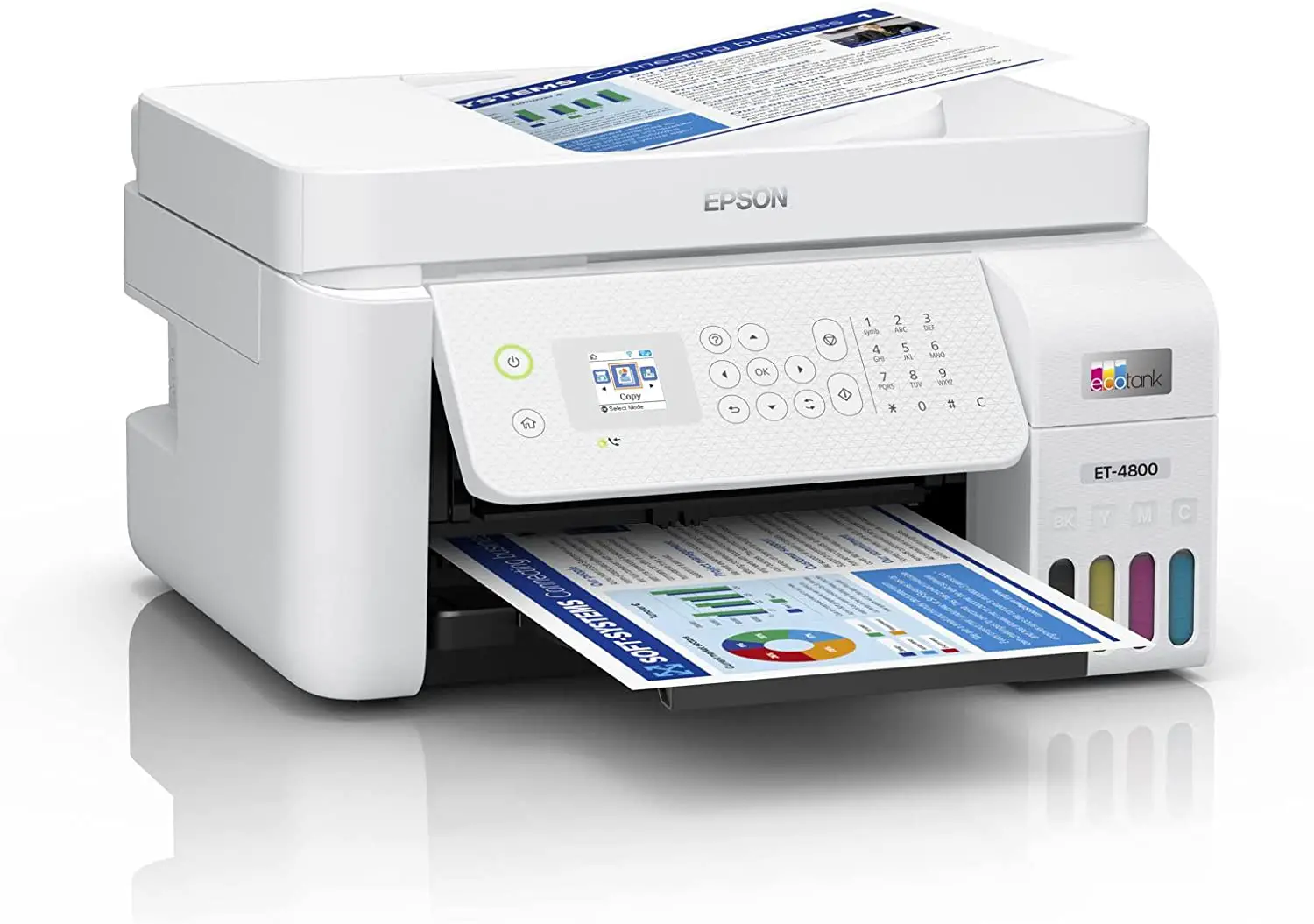
What’s in the box
- Epson EcoTank ET-4800 Printer
- User Manual/Guide
- Setup documentation and software instructions
- 4x Epson 522 Ink Bottles ( CMYK )
- Power Cord
The Epson EcoTank ET-4800 can be a practical sublimation option if you want an EcoTank with scanner, copier, fax, and ADF. The printer also has a 4-in-1 functionality that allows it to copy, scan, and fax in addition to printing. This makes it versatile enough for all your office needs.
Large Ink Tanks
The ET-4800 also boasts a large ink capacity with its integrated refillable ink tanks, which can hold about 65 ml of sublimation ink per Epson 522-style bottle. The tanks are visible from the outside, so you can see ink level at a glance and refill before running dry.
Borderless Printing
Furthermore, the printer offers borderless printing up to 4 x 6 inches, enabling you to create detailed images without worrying about cutting off any edges.
High Resolution
In terms of quality, the ET-4800 uses Epson T522 Inks with 4 different color channels (CMYK) and a resolution of up to 5760 x 1440 dpi for sharp print output. With sublimation ink, final transfer quality depends on the ink, ICC workflow, paper, blank coating, and press settings.
With quality sublimation ink and properly coated blanks, transfers can be bright and durable.
Built-in ADF ( Automatic Document Feeder )
The built-in ADF (Automatic Document Feeder) is useful for scanning, copying, or faxing multi-page documents. It does not matter much for sublimation printing, but it is helpful if you also want an office all-in-one machine.
Finally, the EcoTank ET-4800 is equipped with Wi-Fi capabilities allowing you to connect via mobile devices or computers directly for hassle-free printing. It even comes with additional software such as Epson’s Smart Panel print app so you can manage basic mobile printing tasks from your phone.

These features make the ET-4800 useful if you want an office-style all-in-one that can also be converted for hobby sublimation.
The answer is yes, but only after conversion. The ET-4800 ships with Epson 522 dye ink bottles in the box, but you should not use those bottles if you plan to convert the printer for sublimation. Fill the tanks with compatible sublimation ink before the first ink charge instead.
Because the Epson EcoTank ET-4800 is not sublimation-ready, you have to convert it to sublimation first. Once you have converted, you can use the ET-4800 for sublimation.
You can also check out our guide on choosing the best sublimation printer.
The full step-by-step conversion process is detailed later in this guide. Once converted, treat the ET-4800 as a dedicated sublimation printer. Switching back to regular ink is messy, wasteful, and not recommended.
Best Sublimation Settings for the Epson ET-4800
Once you have converted your Epson EcoTank ET-4800 to sublimation, the next question is what print and press settings to use. Most sublimation projects on the ET-4800 work well at the same baseline temperatures as other Epson EcoTank converted printers, with adjustments for paper type and substrate.
| Substrate | Press Temp | Time | Pressure | Print DPI |
|---|---|---|---|---|
| Polyester Shirt | 385 to 400 F | 45 to 60 sec | Medium | 1440 DPI |
| Sublimation Mug (11 oz) | 360 F | 3 to 4 min (mug press) | Firm | 2880 DPI |
| Hard Substrate (MDF, Aluminum) | 385 F | 60 to 90 sec | Medium-Firm | 2880 DPI |
| Tumbler (20 oz, oven method) | 385 F | 6 to 8 min | Shrink wrap | 2880 DPI |
| Ceramic Coaster | 400 F | 60 sec | Medium | 2880 DPI |
In the Epson driver, set Paper Type to “Premium Presentation Paper Matte” or “Plain/Inkjet Paper” depending on your sublimation paper. Always print mirrored. For best color accuracy, install the ICC profile that matches your sublimation ink brand. The full sublimation printer settings guide covers driver setup per Epson model and OS.
Print quality and ICC profile tips: For most hobby sublimation work, use the driver High or Best Quality setting rather than chasing a specific DPI number. The ET-4800 maxes out at 5760 by 1440 dpi, but quality on the substrate depends more on artwork resolution (300 dpi minimum) and your ICC profile than on a single DPI setting. Install a sublimation-specific ICC profile from your ink supplier when one is available. The default Epson driver profile is built for regular inkjet ink and produces shifted colors with sublimation ink.
Best Sublimation Ink for the Epson ET-4800
The Epson EcoTank ET-4800 uses the Epson 522 ink format, so look for sublimation ink marketed for Epson EcoTank printers and 522-style filling. Avoid random ink that does not clearly support EcoTank refill systems. Three ink brands are commonly recommended for the ET-4800 because they have the right viscosity for the 522 tanks and reliable color output.
Recommended Sublimation Ink for ET-4800:
- Hiipoo Sublimation Ink (4x100ml): Designed for Epson 522 EcoTank printers including the ET-4800. Strong vibrancy, low clogging, ICC profile available on request.
- Printers Jack Sublimation Ink: Long-running budget choice, available in 100ml and 400ml sizes. Reliable for hobbyist use.
- Koala Sublimation Ink: Anti-UV formulation, vibrant colors, compatible with EcoTank ET-2800 through ET-4800.
As an Amazon Associate I earn from qualifying purchases.
Best Sublimation Paper for the Epson ET-4800
The ET-4800 has a standard A4 / Letter paper feed and works with any standard 8.5×11 sublimation paper. Look for paper rated 105 to 125 gsm for the best balance of ink absorption and feed reliability.
Recommended Sublimation Paper for ET-4800:
- A-SUB Sublimation Paper (110 sheets): Most popular choice for EcoTank converted printers. 125 gsm, vibrant transfer, minimal ghosting.
- TexPrint DT Light / XPHR Paper: Premium pick. Higher ink release, ideal for hard substrates and crisp detail.
- Koala Sublimation Paper (120 sheets): Solid mid-range choice. 120 gsm, good for shirts and mugs.
As an Amazon Associate I earn from qualifying purchases.
The full best sublimation papers guide compares 8 paper brands side by side.
ET-4800 vs ET-2800 vs ET-15000: Which Should You Buy?
The ET-4800 sits in the middle of the converted EcoTank lineup. Below the budget-friendly ET-2800 and below the wide-format ET-15000. Here is how the three compare for sublimation use.
| Feature | ET-2800 | ET-4800 | ET-15000 |
|---|---|---|---|
| Max Print Size | 8.5 x 14″ | 8.5 x 14″ | 13 x 19″ |
| ADF (Auto Document Feeder) | No | Yes | No |
| Fax | No | Yes | No |
| Wi-Fi | Yes | Yes | Yes (Ethernet too) |
| Print Speed (color) | 5 ppm | 5 ppm | 10 ppm |
| Print Resolution | 5760 x 1440 | 5760 x 1440 | 4800 x 1200 |
| Best For | Beginners, tightest budget | Home office plus sublimation | Wide-format prints, hard blanks |
| Amazon Link | View ET-2800 | View ET-4800 | View ET-15000 |
The ET-4800 is the right pick if you want the all-in-one office capability (printer plus copier plus scanner plus fax) on top of sublimation. If you only print, the cheaper ET-2800 does the same sublimation job. If you need 13 x 19 inch prints for hard blanks or large shirts, the ET-15000 is the upgrade.
Quick decision guide:
- Choose the ET-2800 if you only need basic sublimation printing and want the lowest starter cost.
- Choose the ET-4800 if you want sublimation plus scanner, copier, fax, and ADF in one machine.
- Choose the ET-15000 if you need 13 x 19 inch prints for large shirts, oversized transfers, or bigger hard blanks.
How to Convert Your ET-4800 to Sublimation (Step by Step)
The ET-4800 is not sublimation-ready out of the box. The full conversion takes about 30 minutes if your supplies are ready. This is the clean conversion process that prevents regular ink from contaminating your sublimation ink.
Important: Only convert a brand-new printer. If the ET-4800 has ever run regular Epson 522 ink, residual dye-based ink in the print head will mix with sublimation ink and produce muddy colors permanently.
Step 1: Gather your supplies before you start. You need a sealed-box ET-4800, a 4-color sublimation ink set (Hiipoo and Printers Jack are the most reliable starter brands), sublimation paper (A-SUB is a solid default), disposable gloves, paper towels, and your design software ready with the manufacturer ICC profile downloaded. Heat-resistant gloves are useful later for pressing mugs, tumblers, or hot blanks, but disposable gloves are enough for filling ink tanks.
Step 2: Begin setup without using the supplied Epson ink. Plug the ET-4800 in and start the initial hardware setup. When the printer reaches the ink-filling step, do not open or install the supplied Epson 522 ink bottles. Set them aside. You will fill the tanks with sublimation ink in the next step before starting the initial ink charge.
Step 3: Fill the ink tanks with sublimation ink. Open each tank cap and fill slowly to the max line. Match the colors carefully (black to black, cyan to cyan, magenta to magenta, yellow to yellow). Cap each tank tightly when done. Wear disposable gloves because sublimation ink can stain skin, clothes, and your work surface. Once all four tanks are filled, continue the on-screen setup and start the initial ink charge.
Step 4: Run the initial ink charge cycle. The printer will run an automatic charge cycle that pulls ink through every print head channel. The Epson manual lists about 11 minutes for the ET-4800 charge, so plan for roughly 10 to 15 minutes in practice. Do not interrupt it or turn the printer off while charging.
Step 5: Print a nozzle check. After the charge completes, print a nozzle check from the printer menu. You should see solid blocks of all 4 colors with no gaps or missing lines. If there are gaps, run the printer head cleaning cycle once and re-check after a 12-hour rest.
Step 6: Install the ICC profile for your ink brand if available. Download the ICC profile from your ink or paper supplier when they provide one. Hiipoo availability varies by product line because some inks are marketed as ICC-free. Printers Jack users often need to request a profile from support. Do not use a random profile unless it matches your printer, ink, and ideally paper. On Windows, right-click the .icc or .icm file and choose Install Profile. On Mac, copy it to /Library/ColorSync/Profiles/ for all users or ~/Library/ColorSync/Profiles/ for your user account. Installing the file is only step one. You still need to assign it in your color-managed print workflow (Photoshop, Affinity, Silhouette Studio, or Cricut Design Space) before you print.
Step 7: Run a first test print. Print a small test design on sublimation paper, coated side facing up. Mirror your design horizontally before sending to print. In the Epson driver, start with Premium Presentation Paper Matte or the paper type recommended by your sublimation paper brand. Use High or Best Quality, turn mirroring on, and disable double color correction if your design software is managing color. Press according to the blank manufacturer instructions. As a starter range, polyester shirts often use 385 to 400 F for 45 to 60 seconds, mugs about 360 F for 3 to 4 minutes in a mug press, and hard substrates around 385 F for 60 to 90 seconds. The first print may look pale on paper and bright after pressing, which is normal for sublimation.
Once converted, print at least one full test page every week to keep the print head clear of dried sublimation ink. Sublimation ink dries faster than regular inkjet ink and an idle print head clogs within 5 to 7 days.
Total Cost of ET-4800 Sublimation Setup
Sublimation looks affordable on the surface, but the total setup cost adds up. This is the realistic breakdown for an ET-4800-based starter setup, broken into one-time and ongoing expenses.
Budget for five buckets: printer, sublimation ink, sublimation paper, heat press or mug press, and practice blanks. The printer is only one part of the setup; the heat press and blanks often decide how expensive the first month feels.
One-time investment: The biggest one-time costs are the printer itself and a heat press. The ET-4800 is the centerpiece. Beyond that, you need a heat press matching your main substrate (mug press for mugs, clamshell for shirts, oven or wrap-style for tumblers). Disposable gloves and a basic infrared thermometer round out the one-time tools.
Ongoing supplies: Sublimation ink for an ET-4800 lasts roughly 6 to 12 months for active home crafters depending on print volume. A 4-color set replaces all four channels at once. Sublimation paper is a per-print cost (you use one sheet per design). Sublimation-coated blanks are the substrate cost and vary widely by type (mugs are inexpensive per unit, tumblers cost more, polyester shirts in bulk are reasonable).
Per-print cost estimate: Once setup is complete, the cost per finished item is much lower than the upfront investment suggests. A printed sublimation mug costs only a few cents in ink and paper plus the cost of the blank itself. Tumblers cost a bit more per unit because of the larger transfer paper. Polyester shirts depend heavily on shirt blank cost.
Hidden costs to plan for: The first batch of prints is often a learning loss. Plan for a small learning loss: often 5 to 10 imperfect blanks during the first setup phase, plus 1 to 3 test blanks whenever you switch to a new substrate type. Replacement parts like a new print head are rare but can occur after years of use. A backup printer is sensible if you start selling consistently because a single print head clog can stop production.
For exact current pricing on each item, check the recommended supplies linked above or compare options on Amazon. Many crafters target a strong material margin on personalized sublimation items, but real profit depends on blanks, wasted prints, packaging, shipping, platform fees, and your time. Treat margin estimates as planning numbers, not guaranteed profit.
Common ET-4800 Sublimation Problems
Below are the most common ET-4800-specific sublimation problems. For deeper diagnostic help on any sublimation issue, including ghosting, banding, color shifts, and transfer failures across every printer brand, the sublimation troubleshooting hub covers every common failure with diagnostic tables and step-by-step fixes.
The ET-4800 shares the same maintenance and troubleshooting profile as other converted Epson EcoTanks. The most frequent issues crafters report are clogging after idle weeks, banding, and color shifts.
Clogged nozzles: Sublimation ink dries faster than regular inkjet ink. Print a nozzle check at least twice per week to keep nozzles healthy. If banding appears, follow the 5-tier unclogging system: nozzle check, standard clean, power clean, 12-hour rest, then deep maintenance.
Banding (horizontal lines): Almost always caused by clogged nozzles or weak yellow channel. The banding fix guide covers Epson EcoTank specifically.
Color shifts (greens look blue, blacks look brown): Install the correct ICC profile for your ink brand. Most converted ET-4800 setups need a Hiipoo or Printers Jack ICC profile, not the default Epson one. Full setup in the ICC profile guide.
Pizza wheel marks: The ET-4800 paper feed rollers can leave faint dotted lines on heavy sublimation paper. Reduce paper weight to 105-110 gsm if marks appear, or disable fast-drying mode in the driver.
Frequently Asked Questions
Is the Epson ET-4800 sublimation ready out of the box?
No. The ET-4800 ships with Epson 522 dye-based ink and is not sublimation-ready out of the box. For sublimation, start with a brand-new printer and fill the tanks with sublimation ink before the first ink charge, instead of using the supplied Epson 522 ink. If regular Epson ink has already run through the print head, the conversion becomes messy and color results are less predictable. Once converted, treat the ET-4800 as a dedicated sublimation printer, since switching back to regular ink is wasteful and not recommended.
What sublimation ink works best in the Epson ET-4800?
Hiipoo, Printers Jack, and Koala are common starter choices for converted Epson EcoTank printers, including the ET-4800. The best ink is the one that clearly supports Epson 522-style EcoTank filling and gives you a usable color workflow. Check whether your exact ink line provides an ICC profile, markets itself as ICC-free, or requires contacting support before assuming a profile is available. Whichever brand you choose, do not install the default Epson profile because it is built for regular inkjet ink.
Can the ET-4800 print 13 x 19 inches for hard blanks?
No. The ET-4800 maxes out at 8.5 x 14 inches. For 13 x 19 inch sublimation prints, the Epson ET-15000 is the standard recommendation among hobby crafters. That size limit matters if you want oversized shirt designs or larger hard blanks. The ET-4800 still covers most shirts, mugs, tumblers, and small hard blanks.
What temperature and time should I use with ET-4800 prints?
For most polyester shirts, 385 to 400 F for 45 to 60 seconds with medium pressure works well. Sublimation mugs press at 360 F for 3 to 4 minutes in a mug press. Hard substrates such as metal photo panels or ceramic tiles often need about 385 F for 60 to 90 seconds, but always follow the blank supplier instructions first. The full sublimation temperature chart covers 22+ substrates.
Final Thoughts
Final verdict: yes, the Epson EcoTank ET-4800 can be used for sublimation after a clean conversion.
Since the ET-4800 is a budget-friendly printer, it is also one of the best Epson sublimation printers, making it ideal for those who are just getting started with this type of printing technique.
If you want an affordable EcoTank with scanner, copier, fax, and ADF that you can also convert for hobby sublimation, the ET-4800 is a reasonable starter option.


Emily Johnson is a DIY crafter and the founder of SublimationGuides.com. She started out repairing and sewing clothes for her two sons, then discovered sublimation as a way to personalize her makes. Today she researches and shares honest, tested guides on sublimation settings, troubleshooting, and equipment.